
Dear All….
I am extremely excited to announce the launch of Mama Mimi’s Premium Business Franchise. This lucrative business opportunity allows for you – the business owner to be a part of a community upliftment programme. (more…)
Dear All….
I am extremely excited to announce the launch of Mama Mimi’s Premium Business Franchise. This lucrative business opportunity allows for you – the business owner to be a part of a community upliftment programme. (more…)
 It’s that time of the year again, every scammer out there is sending emails pushing their luck and trying to catch an innocent person out. Today, online fraud is a large-scale and highly lucrative criminal enterprise. Amongst the most popular of the scams out there are scammers claiming to be from SARS or other investment schemes and of course the ever popular “cash prize” – claiming that you have won a ridiculous amount of money (even though you had never even entered a competition to begin with!).
The scariest part is that it doesn’t take much for a hacker to create an email that helps them to pretend to be from a trusted bank. Once they have convinced you that they are from a reliable bank or are a trusted retailer, they ask for your login details and then obtain your confidential information in a few easy steps! There are over 200million scam emails (formally known as “phishing” emails) sent every day – so there is a pretty good chance that one will land in your inbox! Unfortunately it’s the small and midsize companies that are often the main target because they don’t always have the capital to spend on IT security infrastructure. So how do you prevent falling into this trap and what are the things to look out for? We have identified these and listed them below…
LOOK OUT FOR THE FOLLOWING TO DETERMINE WHETHER OR NOT THE EMAIL IS A SCAM:
WHAT TO DO IF YOU RECEIVE A SCAM EMAIL?
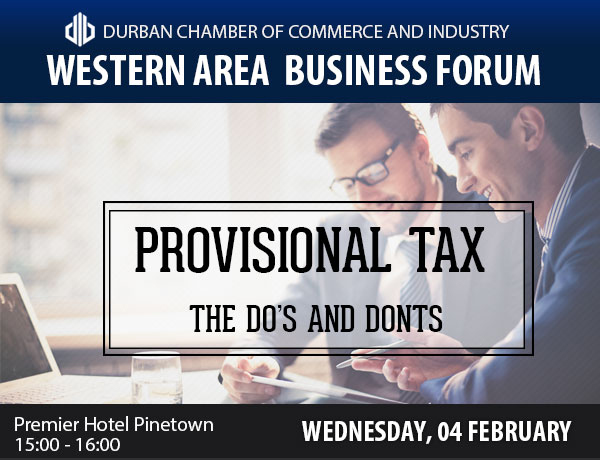 Owner of PATC, Gavin Bacon, recently gave a talk at the Premier Hotel in Pinetown for the annual Durban Chamber of Commerce and Industry – Western Area Business Forum. Bacon’s aim was not to give a lecture and he did not intend on making everybody in the room proficient in Provisional Tax but he rather chose to touch on the various aspects of Provisional Tax so that the audience was filled with questions and a desire to know more! He wanted to encourage people to seek further advice and consult Tax Practioners and Professionals. We have summarized the talk below for those who were unable to attend. (more…)
The 30th of this month (January 2015) marks the deadline for provisional taxpayers (individuals and trusts) to pay their taxes. Doing your taxes can be a daunting task but doesn’t necessarily need to be. PATC (Professional Accountants and Tax Consultants) is going to provide you with a few tips to stay on top of your taxes and deadlines. (more…)
PATC (Professional Accountants and Tax Consultants) are excited to announce the recent partnering with South Africa’s number one Sage Pastel Payroll Business partner – Ritzy IT.

Established in 1993, Ritzy IT has a strong history of business excellence and knowledge. Ritzy IT specialises in Accounting, Financial, Payroll, Payroll Bureau and Business Solutions. Their superior software solutions deliver competitive advantages and increase efficiency and profitability. Ritzy have partnered with us as their preferred and trusted Accounting and Tax service for their clients.
PATC (Professional Accountants and Tax Consultants) have always focused on Accounting, Bookkeeping and Tax and consequently “Pastel” has never featured on our list of available services. And Ritzy IT mentioned that their clients are forever requesting a referral for a trusted and experienced accounting firm. Therefore Partnering with Ritzy IT just made sense for both parties involved.
Benefits to our PATC (Professional Accountants and Tax Consultants) clients;
– Rates are cheaper.
– Hourly rates (where applicable) are less.
– Ritzy will give you a kickback on the rebate that they earn from Pastel.
– Excellent after sales service, telephonic and onsite support.
Ritzy IT has agreed to some exclusive specials for PATC (Professional Accountants and Tax Consultants) ONLY, this is an exclusive and limited offer. So what are you waiting for? Join PATC by the 15th December 2014 and you will receive the following (valued over R4500);
For more information or any other queries please contact PATC (Professional Accountants and Tax Consultants) today!

What is Dividends Tax?
Dividends Tax is a tax charged at 15% on shareholders when dividends are paid to them. Under normal circumstances Dividends Tax is withheld from the shareholders by a withholding agent (by the company paying the dividend/where a regulated intermediary is involved). A Dividend is in essence any payment made by a company to a shareholder for a share in their company (this excludes the return of contributed tax capital). (more…)
2015 Budget Tips

So many businesses either shut down or become very quiet over the festive season. You might however be stuck in the office until Christmas Eve, due to leave restrictions or business obligations and commitments. Why not use this quiet time in the office to plan your business or personal budget for 2015? Besides, it’s difficult to enjoy the holidays or your time off when you’re worried about money! Consider the following 2015 Budgeting Tips set out by PATC (Professional Accountants and Tax Consultants)… (more…)
 What is CIPC?
The CIPC (Companies and Intellectual Property Commission) is responsible for the registration of companies, co-operatives and Intellectual Property Rights and the maintenance thereof. Some of the other functions of this commissioning body include; promotion of education and awareness of a company and its intellectual property law, enforcement of relevant legislation, monitoring of compliance with financial reporting standards and making recommendations to the FRSC (Financial Reporting Standards Council). It is also the CIPC’s responsibility to; promote compliance of relevant legislation, license Business rescue practitioners and to disclose information on its business registers.
How do I know if I am meant to pay CIPC Returns?
By law, all companies and close corporations (cc) are required to file their annual returns with CIPC. CIPC needs the information gained from returns to ensure that it is in possession of the latest information of the company or close corporation and to determine whether the company or close corporation is conducting business related activities.
When are my CIPC Returns due?
CIPC Returns are due on the last working day of the month of the anniversary of registration of the company/cc (not a Saturday, Sunday or Public Holiday).
Contact the CIPC here: http://www.cipc.co.za/index.php/contact-us/enquiries/
For any further help, feel free to contact PATC (Professional Accountants and Tax Consultants)

So…it’s Monday and your “Sunday Blues” have followed you into the office. There is always that one person at work with an overwhelmingly abnormal, unlimited source of energy and determination and you just don’t understand where they are getting it from? We have compiled a list of National and International Entrepreneurs to help give you some of this much needed inspiration and motivation! (more…)

Every business needs goals regardless of where they are in the business cycle. We need goals to be able to succeed, grow and maintain enthusiasm for our businesses.
It is also important to note that small businesses require a lot of time and sacrifices in order for them to succeed. You may need to give up things like family time in order to put all your energy into your business, especially in the growing phases of the business life cycle. If you are planning on starting a small business, you need to be aware of the fact that it will require huge dedication. Is is also important to learn how to delegate some of the work, hire the right people so that they can share the work load with you. PATC can help with all your financial requirements, including the beginning phases of starting up a business. It makes sense to start with a business plan.
We all have big ideas for our businesses but the problem comes when we require the financial aid for these ideas. When you approach investors or banks to assist you, you need to present them with a professional business plan. This is like a CV that you would send to a prospective employer. PATC will help you with this business plan so that you do not need to feel overwhelmed with terms like; proposed site, start-up capital, collateral or security loans, interest rates, balance sheets, forecasted income statements, cash flow projection…and the list goes on!
Make an appointment so that we can guide you through the above process. The first +- 1 hour meeting is on us – we want to see you make a success of your business.
If you enjoyed our blog you might find the following articles useful:
Why Do Small Businesses Need An Accountant?