
SARS is Done Asking Nicely

This article first appeared on BusinessTech on 28 August 2021.

The National Prosecuting Authority (NPA) is issuing summonses to taxpayers with outstanding tax returns as part of a continued compliance drive by the South African Revenue Service (SARS).

SARS commissioner Edward Kieswetter has pledged that the tax body will make life difficult for non-compliant taxpayers, a promise he has kept, said specialist firm Tax Consulting SA.

“Those who decided to ignore his words of caution may soon be summoned to appear in court on criminal charges, even if they have left South Africa,” the firm said.

“From the summonses we have seen, it is evident that SARS and the NPA treat this form of delinquency very seriously.”

The charge sheets are prepared carefully, and every instance of non-compliance, for every tax type, counts towards a separate charge, Tax Consulting SA said.

Some taxpayers face up to 30 counts of contravening the Tax Administration Act. “The gravity is underscored by the fact that it appears that the Hawks have been involved in investigating some of these cases, who serve these summonses on the taxpayer personally.”

Enforcement by example

SARS has undertaken to make it a costly exercise for taxpayers who flout their tax obligations, Tax Consulting SA said. “A key part of this initiative is to make an example of delinquent taxpayers.

“For South African abroad, SARS and National Treasury are on record that they are aware of the pervasive non-compliance among expatriates, which was one of the main drivers for the enactment of the “expat tax”.

Tax Consulting SA said that the tax body has made it clear that this is a key area of enforcement for the institution, and it will only be foolish to assume that you are beyond the NPA’s reach.

If you are unsure of your obligations, it will be prudent to diagnose your tax affairs, the firm said. “If you are found to be non-compliant, it will be wise to rectify your position before you receive an invitation from the NPA to return to South Africa.”

What if I live abroad?

There is a sentiment among South Africans who have left our shores that their South African tax obligations are in the rear-view mirror, Tax Consulting SA said.

“Perhaps this because they believe that SARS cannot be bothered to enforce against taxpayers who no longer reside in South Africa.

“It is important to understand that the failure to file returns constitutes a criminal offence under South African law and nothing precludes the NPA from summoning a taxpayer to face criminal charges in South Africa long after they left the country.

“Criminal proceedings may still be instituted up to 20 years after the offence was committed.”

Jail time

SARS issued a press release earlier this week, pointing to a man who defrauded several taxpayers, who was sentenced to 48 years direct imprisonment after being found guilty on charges of theft, fraud and contravention of the Prevention of Organised Crime Act (POCA).

The Boksburg Magistrate’s Court heard how SARS had received a complaint from a taxpayer that his personal income tax refund was paid into an incorrect bank account. SARS said it conducted an investigation and found that the refund was paid into an FNB account in the name of Khathutshelo Mashau.

It was also found that several refunds for other taxpayers were paid into the same account. The affected taxpayers denied knowing the FNB account that received the refunds. They also stated that they did not request that their personal information and bank accounts be changed to Khathutshelo Mashau.

Mashau also had another bank account with Capitec, into which four fraudulent personal income tax refunds were paid. No recoveries were made as all monies were withdrawn when the investigation started.

SARS commissioner Edward Kieswetter warned taxpayers to use only registered tax practitioners to assist them with their tax affairs.

“Persons who have no tax qualifications and who promise taxpayers huge refunds are likely to be engaged in fraudulent activities which will harm the taxpayer. Taxpayers must report such persons immediately so that other taxpayers can be protected from these criminals.

“SARS makes it clear to taxpayers and provides certainty on which channels to use to transact with SARS, and these are the only channels to use. If these channels are not sufficient to deal with a taxpayer’s needs, they should use the services of a recognised tax practitioner,” commissioner Kieswetter said.

The link to the original article can be found here.

Contact PATC Today

If you need assistance in your business’ finances, from accounting to tax consulting and financial management, PATC can help you. Contact us today and let us know how we can help you.

Now read: Personal Taxation on Cryptocurrency

 

Personal Taxation on Cryptocurrency

Understanding personal taxation and cryptocurrency

Q: What info is required to be submitted to SARS regarding Cryptocurrency transactions and in what format?
A: You will need to treat it like transactions and keep a detailed report of all your transactions. For example: the date you purchased cryptocurrency, the cost amount spent on the asset, the date you sold the cryptocurrency, the amount you sold it for and the profit / loss you made.

Your purchases of cryptocurrencies will be reported on the balance sheet (asset). Treat it exactly the way you would treat the purchase of stock, and your profit will be reported on your income statement. Only  once you have sold your cryptocurrency will the profit be realised by you and declared as profit to SARS.

Example: On 17/03/2020 you bought cryptocurrency at a cost of R50 000 and on 23/06/2020 you sold it for
R85 000. The Profit you made will then be R35 000. Only the Profit is taxable.

However, if you trade regularly, and it is part of your income, it can be seen as revenue, and therefore be treated as revenue (tax). If you have a full-time job and you only trade with cryptocurrencies as a hobby your profit will then be treated as capital gains tax. SARS will accept any format as long as they can read what is on the document and what currency you bought. If it is a Word document, PDF, Excel or handwritten on paper, as long as all the information is visible and clear, they will accept it. When you buy or sell, it needs to be a detailed record in any format for SARS to accept. This includes short and long-term trades, staking and interest bearing savings accounts on exchanges, as well as de-fi opportunities. Generally short-term trades are seen as revenue; therefore, you pay full tax on the profit. Generally long-term trades are seen as capital gain; therefore, you will pay capital gains tax on the profit. Only the buy and sell of cryptocurrencies is in this case important to SARS.

Q: What deductions are permissible for cryptocurrency transactions i.e. Cost of advisory services, ISP costs, area of dwelling, rent/bond, electricity, laptop etc.
A: Any expense “incurred in the production of income” is tax deductible. So, to answer your question,  you can deduct advisory costs, ISP costs area of dwelling, electricity and your laptop. However, if you deduct your laptop, it depreciates over a period of 3 years.

If you want to claim your area of dwelling, SARS generally requires the blueprints of your property, where you highlight the area that you use mainly for work, if it is reasonable. Example: If your property is 200m² and you only use 16m² as your main office, this is how you will calculate the percentage of interest deductible on your bond: 16/200 = 8%. This means you can claim 8% if it is reasonable.

Q: How do they want you to report earnings from any cryptocurrency that you are earning interest on, on a crypto platform i.e., 4.4% on Ethereum, 10.7% on Tron, 5.8% on Chainlink?
A: You will need to pay tax on any interest received on any type of cryptocurrency, irrespective of the platform. Example: If your crypto is R60 000 and within months the interest you received accumulates to R66 000, you will need to pay tax on that R6000 interest that you received.

Q: Do they just want the annualised earning per token per year?
A: Yes, per financial year from Mar to Feb.

Q: Is it a taxable event when you realise and re-capitalise your investment on a monthly or quarterly basis?
A: Monthly is taxable. Any transaction made by you if it is per day or per week, it is taxable. Per transaction per day is taxable.

Q: Do they want the interest earned itemised per token or collated into a single amount?
A: SARS will be happy with a single amount, if it was prepared by a 3rd party, meaning they will then issue you an IT3b certificate, showing that single amount. If it is prepared by yourself, SARS generally requires a breakdown of the itemised earnings per token.

Q: If you have funds that you have put into a De-Fi project on an overseas platform that is paid interest for staking, the interest is payable in the token daily and re-invested for compounding purposes, how is this reported?
A: When it is capitalized or not, you will need to pay tax on any interest received or profit gained from a transaction. Your token daily income / profit will also need to be paid tax. You will need to keep a detailed report of all transactions and interest received.

Q: If one wants to legally transfer token from SA to an overseas platform, what are the permissions required to do this? As SARS has now deemed this to be a criminal offence.
A: You will need to get a tax clearance per transaction every time for investment purposes. So, if you have 60 transactions, you will need a tax clearance for every transaction made, which totals to 60.

Up to R1Mil SARS sees it as discretionary allowance, meaning they don’t ask questions and you can do what your heart desires with that R1m. After that, the next R10Mil, will need a specific breakdown, where you want to invest, why you want to invest, and when you want to invest, any important reasons for investing they will require.

SARS allows R1Mil per person, per calendar year to invest in overseas platforms, as discretionary allowance, if you have a tax clearance for all transactions made.

Q: Who do we need to contact to complete any documentation required for Reserve Bank permission.
A: Your personal bank.

Q: I understand the difference between investing, for the growth of wealth (capital gain) and trading, to derive a short term profit (income stream), and that they are reported on different sections of the tax return forms.
A: Yes, that is correct.

Q: Does SARS allow for the expenditure required for these independent ventures i.e.

  1. Area of residence used in the pursuit of income: Yes
  2. Cost of ISP: Yes
  3. Subscriptions to Consultative Services: Yes
  4. Depreciation of hardware i.e. Laptop: Yes
  • Furniture depreciates over 6 years
  • Equipment example: printer depreciates over 5 years
  • Laptop depreciates over 3 years

Q: Are there a specific number of trades per annum that need to be conducted to qualify for these deductibles? Is it based on the Rand Value profit from these endeavours?
A: No, only when you made a profit, will you be allowed to make these deductions. You are allowed to pile up your deductions over a long period and once you made a transaction that made profit, you can deduct one big amount. But it all depends on if it is reasonable to SARS. If, for example, you only made 3 transactions per year, SARS will then divide those 3 transactions with every day of the year: 3/365. This will intitle them to make a conclusion of what you can deduct, depending on the time spent on every transaction. (ie a very few transaction will be frowned upon if you try claim you third bedroom as an expense.

Q: Historically, I have had the deductibles refused, but the profits still taxed, and told the volume of trades did not justify the deductions.  How can they still tax this as a revenue stream them?
A: Section 11A of the Income Tax Act entitles you to claim any expenses. If you are not happy that SARS disallowed your deductibles, you can do an objection, which then requires an agent working at SARS, to go through everything thoroughly.

Q: SARS, in their documentation, refer to Source Codes when completing the tax return. Where does one get the prerequisite Source Codes for income earned, or capital gains realised?
A: On your tax return on eFiling, under your income statement they will show the code next to the figures that needs to be captured. When you hover your curser over the number it will pop up a description for what figure needs to be captured. You don’t need to know the codes by heart. You can also google Source Code SARS.

This article is intended for information purposes only. Each case should be evaluated on its own merit and is subject to a consultation.

Source and credits:

Position Paper on Crypton Currencies (Crypto Assets Regulatory Working Group) – https://www.resbank.co.za/en/home/publications/publication-detail-pages/media-releases/2021/IFWG-CAR-Working-Group-position-paper-on-crypto-assets
South African Revenue Services (SARS)
Tax Tim
Sanlam

Contact PATC Today

If you need assistance in your business’ finances, from accounting to tax consulting and financial management, PATC can help you. Contact us today and let us know how we can help you.

Now Read: Understanding the Principles of ISCQ1

Understanding the Principles of ISQC 1

Business meetingThe objective of the firm is to establish and maintain a system of quality control to provide it with reasonable assurance that:

  • The firm and its personnel comply with professional standards and applicable legal and regulatory requirements; and
  • Reports issued by the firm or engagement partners are appropriate in the circumstances.

(more…)

Implementing Liquidation Procedures for The Business

LawThe liquidation process can be defined as the process in which a company voluntarily proceeds to declare itself as being insolvent or where a creditor of the company brings an application to court in order to have the company declared insolvent. The result thereof is that the company may no longer proceed to operate its business. Sections 79 to 83 of the Companies Act No 71 of 2008 (hereinafter “the Act”) provides the procedure to be followed when winding up a company, either voluntarily or through a court order (i.e. involuntary liquidation). (more…)

Finalising and Signing Off the Financial Statements

Man signing a documentOnly one director is required by law to sign the balance sheet on behalf of the board but, in the case of companies with shares traded on a market, it is quite common to see the balance sheet signed by two directors, for example, the Chairman and the Finance Director. To some extent this is probably a hangover from the days, prior to the Companies Act 1989, when the balance sheet had to be signed by two directors. (more…)

Using Break-Even Analysis To Make Business Decisions

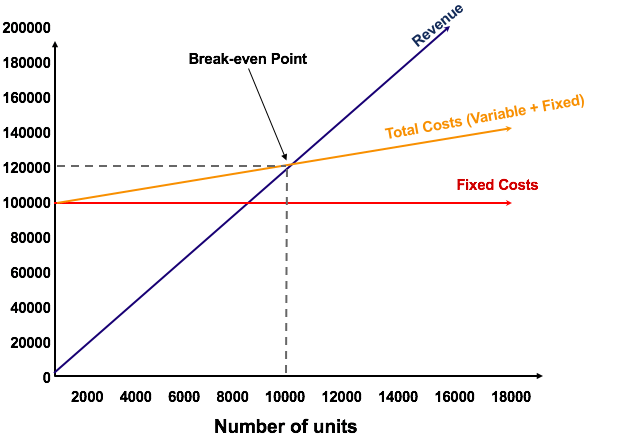
In the graph, the point at which total fixed and variable costs are equal to total revenues is known as the break-even point. At the break-even point, a business does not make a profit or loss. Therefore, the break-even point is often referred to as the “no-profit” or “no-loss point.” Anything above this point would be a profit for the business and vice versa. (more…)

Credit Risk Explained

person using a laptop and holding a bank cardCredit risk is the possibility of a loss resulting from a borrower’s failure to repay a loan or meet contractual obligations. Traditionally, it refers to the risk that a lender may not receive the owed principal and interest, which results in an interruption of cash flows and increased costs for collection. Excess cash flows may be written to provide additional cover for credit risk. When a lender faces heightened credit risk, it can be mitigated via a higher coupon rate, which provides for greater cash flows. (more…)

Things to Consider When Setting and Communicating Credit Limits

woman on the phone in officeCredit limits serve a variety of purposes. Companies can use them as a guideline for order approval, to minimize the upward spiral of orders or to call immediate attention to a change in a customer’s purchasing or payment behaviour.

Often the tendency is to let the credit limit simply become a matter of course, which means that a company approves any order the customer places. This basis for credit decisions should be reserved for only very substantial and financially sound customers. Consider the following information when working with credit limits: (more…)

Maintaining and Updating Employee Payroll Records

Man working on laptopOne of the primary responsibilities of the HR department is to maintain employee records and regularly keep them updated. It is not just a good practice but it is also made mandatory by the law. These records help companies gather and analyze comprehensive information about their workforce at a micro as well as macro level.

How to Maintain and Update Employee Payroll Records

(more…)